
Jefferson City's humid continental climate brings hot summers that push gophers to deeper tunnels and cold winters that concentrate activity near building foundations. Older homes near the Missouri State Capitol and in East Jefferson City often sit on established lawns with compacted clay soils that make standard traps less effective and require longer probe times to locate active runs. Technicians working these neighborhoods routinely check for damage along Jefferson Landing State Historic Site edges where untreated yards allow colonies to expand into adjacent properties.
Gopher work in Cole County differs from jobs in nearby Columbia or Sedalia because the rolling terrain and frequent freeze-thaw cycles create shifting soil that collapses shallow bait stations. Experienced crews use cinch traps or aluminum phosphide tablets placed only in active tunnels after a thorough mapping pass, then backfill to prevent re-entry. Homeowners near the Missouri Governor's Mansion frequently call after noticing fresh mounds in spring because winter snow cover hides early activity until lawns begin to heave.
DIY attempts with gas cartridges or flooding often fail here because gopher systems in local silt-loam soils extend under driveways and sidewalks, allowing animals to bypass treated sections. ClearHome Control crews document every tunnel with flags, re-inspect after 48 hours, and leave the site only when no fresh mounds appear for a full week. This method accounts for the county's typical housing stock of 1950s-1970s builds where utility lines and mature trees complicate access.
Technician insight
In Jefferson City the thing that catches most people out with gopher work is the clay-heavy soil around older East Jefferson City homes; it shifts with every freeze-thaw cycle and lets new tunnels open right next to the ones we just treated, so we always flag and recheck the same spots a week later instead of assuming one visit is enough.
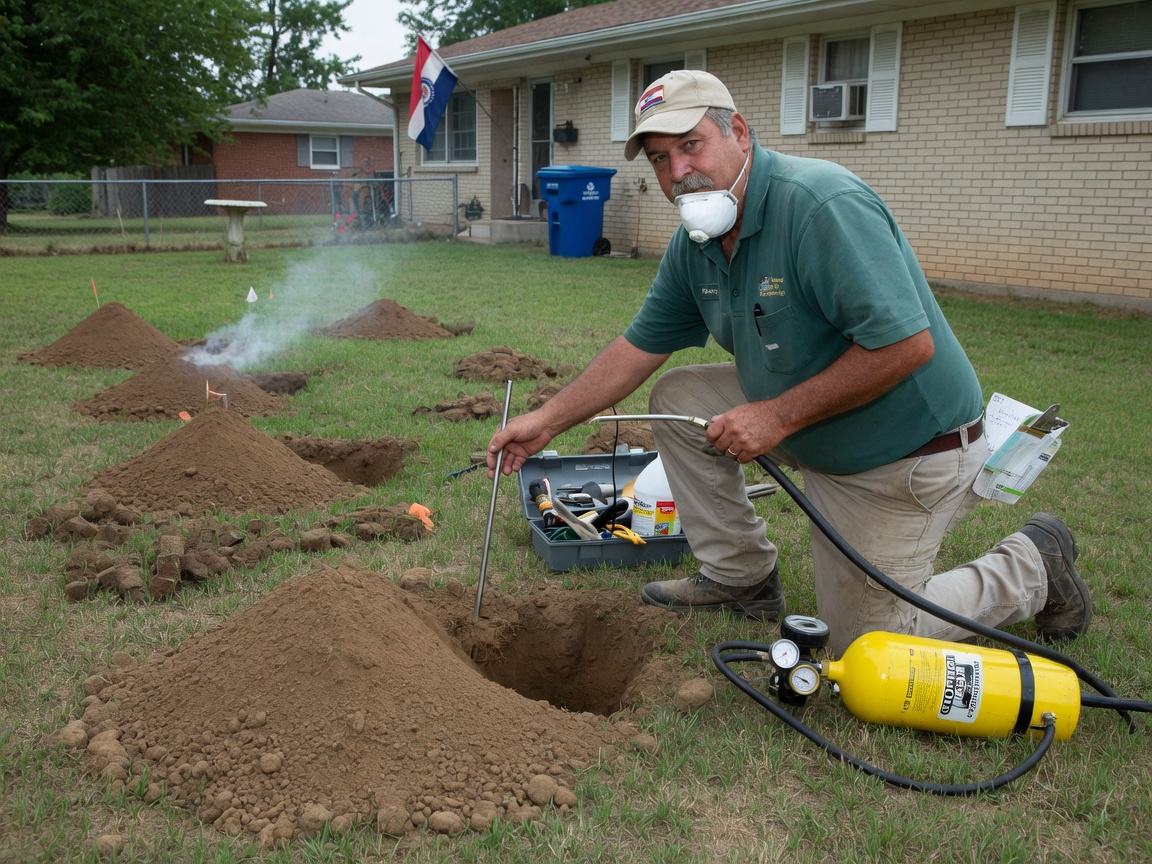
Mounds Behind 1950s Home Near Capitol
Fresh mounds appeared overnight along the back fence of a house two blocks from the Missouri State Capitol. Mapping showed three connected tunnels running under the driveway. Cinch traps were set in the main runs and checked the next morning. No new activity appeared after the one-week follow-up and the yard stayed flat through the rest of the season.
Gopher Exterminator Services We Offer
✓Active Burrow Mapping
Technicians probe and flag every live tunnel on the property to locate main runs before any treatment begins.
✓Cinch Trap Installation
Mechanical traps placed in active tunnels provide immediate removal without chemicals and are checked daily until activity stops.
✓Aluminum Phosphide Treatment
Registered fumigant applied only in confirmed active burrows for properties where trapping access is limited by pavement or slopes.
✓Perimeter Barrier Installation
Underground mesh or gravel barriers installed along foundation lines to stop new colonies from moving in from neighboring lots.
✓Post-Treatment Monitoring
Follow-up visits at 48 hours and one week to confirm zero fresh mounds and re-treat any missed tunnels.
Gopher Exterminator Cost in Jefferson City, MO
| Service | Typical Range | What Affects It |
|---|---|---|
| Initial Gopher Exterminator Visit | $225–$375 | Includes mapping and first treatment; price rises with multiple colonies or difficult access under pavement. |
| Follow-Up Inspection | $75–$125 | Per visit; often included in initial package but charged separately on large lots. |
| Perimeter Barrier Add-On | $400–$850 | Mesh or gravel installed along foundation; cost depends on linear footage and soil conditions. |
| Commercial Lot Treatment | $500–$950 | Larger acreage near Downtown or East Jefferson City requires extended mapping time. |
Ranges are typical for Jefferson City, MO and confirmed with an exact written quote before any work starts.
How it works
- 1
Site Inspection
Walk the full yard including edges near sidewalks and driveways to locate fresh mounds and determine tunnel direction.
- 2
Tunnel Mapping
Use probes to trace main runs and mark each active location with flags for precise treatment placement.
- 3
Treatment Application
Install cinch traps or apply aluminum phosphide tablets only in confirmed live tunnels based on mapping results.
- 4
Follow-Up Checks
Return after 48 hours and again at seven days to verify no new activity and close out the job.
Pricing
Upfront quotes based on property size and number of active systems; most residential jobs fall in the mid-hundreds.