
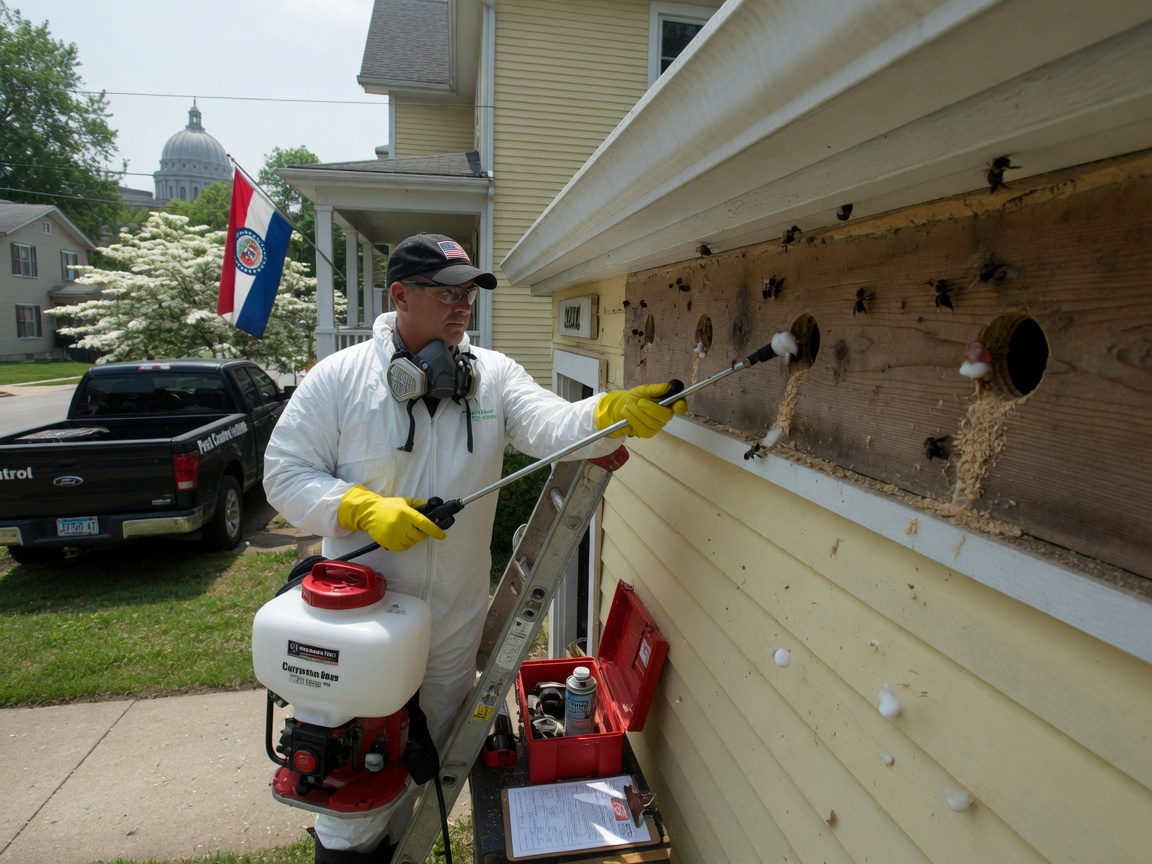
Carpenter bees bore into untreated or weathered wood siding, fascia, and decking common in older Cole County homes around Downtown Jefferson City and near the Missouri State Capitol. Hot humid summers accelerate adult activity while cold winters push surviving larvae deeper into galleries, requiring treatment that reaches beyond surface holes. We use dust formulations that travel through existing tunnels and contact emerging bees without needing full wood replacement on most visits.
East Jefferson City properties built before widespread vinyl siding often have exposed pine or cedar trim that draws nesting females each spring. Nearby Columbia and Sedalia see similar pressure but Jefferson City’s river-adjacent humidity keeps wood moist longer, increasing chew-through speed on untreated eaves. Edge cases include active galleries inside porch ceilings where vibration from traffic can dislodge frass onto walkways below.
We avoid broad spraying near the Missouri Governor’s Mansion or Jefferson Landing State Historic Site to limit impact on non-target pollinators. Treatments focus on entry points and residual dust inside cavities, with follow-up visits scheduled after peak flight periods in late May. Homeowners who paint or seal wood after treatment reduce future pressure more effectively than those who only request annual sprays.
Soil conditions along the Missouri River corridor can keep crawl spaces damper, encouraging bees to move upward into rim joists when ground-level wood stays saturated. We inspect both exterior trim and accessible attic framing on every call to catch satellite nests before they expand.
Technician insight
In Jefferson City the thing that catches most people out with carpenter bees is older pine trim on East Jefferson City homes that stays shaded and damp; the cold winters do not kill the larvae inside deep galleries, so one spring spray rarely finishes the job without follow-up dust inside the tunnels.
Downtown home near Capitol
Homeowner noticed fresh sawdust on porch railings of a 1940s house two blocks from the Missouri State Capitol. We found multiple galleries in the fascia and one extending into the attic rim joist. Dust was applied through existing holes, entrances sealed, and a second visit confirmed no new activity after the main flight period.
Carpenter Bees Exterminator Services We Offer
✓Exterior Wood Treatment
Dust and residual application into active bore holes on siding, fascia, and trim to stop further tunneling.
✓Attic and Soffit Inspection
Targeted search for galleries inside attics and soffits common in pre-1970 Cole County homes.
✓Deck and Porch Control
Treatment of exposed deck joists and porch ceilings where carpenter bees nest in East Jefferson City residences.
✓Historic Structure Protection
Low-impact methods for older wooden buildings near the Missouri State Capitol and Jefferson Landing State Historic Site.
✓Seasonal Re-Entry Sealing
Filling and sealing holes after treatment to prevent reuse in subsequent seasons.
Carpenter Bees Exterminator Cost in Jefferson City, MO
| Service | Typical Range | What Affects It |
|---|---|---|
| Single-family home inspection and treatment | $225–$475 | Varies with number of active holes and whether attic access is needed. |
| Deck or porch only treatment | $150–$300 | Higher when multiple levels or covered ceilings are involved. |
| Historic home or multi-unit follow-up | $175–$350 | Extra time required for careful product placement near landmarks. |
Ranges are typical for Jefferson City, MO and confirmed with an exact written quote before any work starts.
How it works
- 1
On-Site Inspection
We examine all exposed wood on the structure, map active holes, and note moisture levels that influence bee activity.
- 2
Targeted Dust Application
Dust is puffed directly into galleries so it contacts adults and larvae without broadcast spraying.
- 3
Hole Sealing
Once activity stops we fill entrances with wood putty or caulk matched to existing finishes.
- 4
Follow-Up Visit
A return trip checks for new holes and applies residual product if spring flight extends later than expected.
Pricing
Pricing based on number of structures treated and extent of galleries found during inspection.